
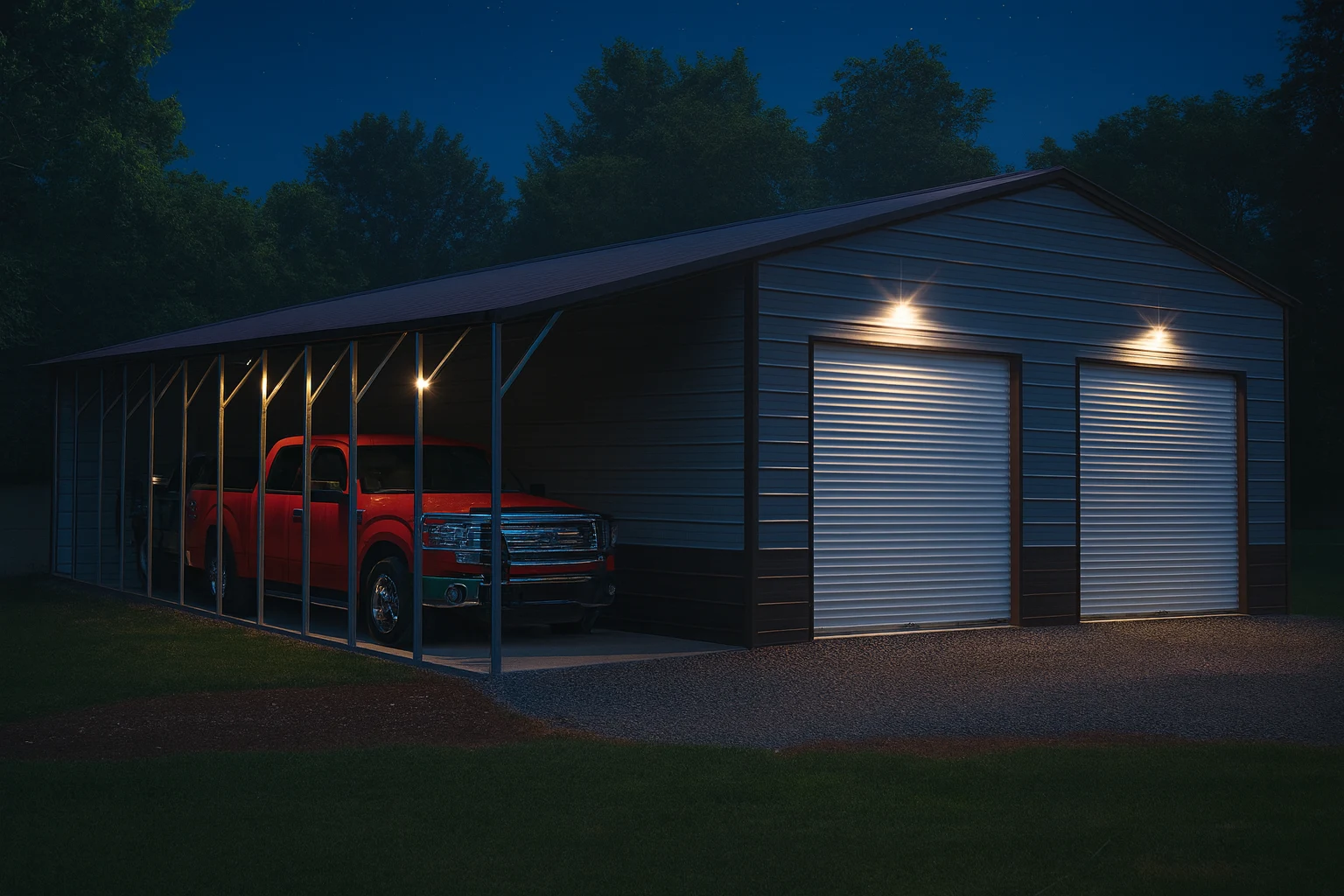
Wash your metal building once or twice a year with a mild detergent, a soft brush, and a garden hose or low-pressure sprayer. That's close to the whole maintenance program. The most common mistake isn't neglect — it's a pressure washer on a high setting, which drives water past seams and under panel laps and can strip the factory finish.
Why Bother
The panel finish is what protects the steel. Dirt, pollen, tree sap, and salt hold moisture against that finish and accelerate chalking and fade. In coastal areas, salt deposits are corrosive on their own.
Washing also lets you notice things early — a loosening fastener, a lifted seam, a scratch through the coating — while they're still cheap to fix.
How Often
| Environment | Frequency |
|---|---|
| Typical residential | Once a year |
| Under trees, heavy pollen | Twice a year |
| Coastal / salt air | Every 3–4 months |
| Agricultural, dusty | Twice a year |
| Near a busy road | Twice a year |
Spring is the natural default — pollen, winter grime, and salt all come off at once.
What You Need
- Garden hose, or a pressure washer on its lowest setting with a wide fan tip
- Mild detergent — car wash soap or dish soap in warm water
- Soft-bristle brush on an extension pole
- Ladder if you can work safely from one
The Process
- Rinse top to bottom to remove loose debris first.
- Apply detergent with the brush, working in sections so it doesn't dry on the panel.
- Scrub gently with the soft brush, following the panel direction rather than across it.
- Rinse thoroughly, again top to bottom, until no detergent remains. Residue attracts dirt.
- Let it air dry. No toweling required.
Work in shade or on an overcast day if you can. Detergent drying on hot panels leaves streaks.
What Not to Do
Don't use high pressure. This is the big one. High-pressure water forces its way under panel laps, past sealant, and around fasteners — creating leaks in a building that wasn't leaking. It can also strip the coating outright.
Don't use abrasives. Steel wool, scouring pads, and wire brushes remove the finish along with the dirt. Once the coating is gone, that spot rusts.
Don't use harsh chemicals. Bleach, strong solvents, and acidic cleaners can damage the finish and are frequently named in warranty exclusions.
Don't scrub across panel ribs. Follow the panel direction.
Don't ignore the manufacturer's guidance. Warranties on panel finishes typically specify acceptable cleaning methods. Deviating can void coverage on exactly the thing you're trying to protect.
Spot Problems
Tree sap and tar. Mineral spirits on a soft cloth, applied to the spot only, rinsed immediately afterward.
Rust spots. Usually at a scratch or a fastener. Clean gently, prime with a compatible primer, and touch up with matching paint. Address it early — rust doesn't stop on its own.
Mildew. Common on shaded north walls. A mild detergent solution and a soft brush handles most of it. Skip the bleach.
Chalking. A faint white residue on older panels, and normal aging of the finish. Washing removes the loose chalk. Heavy chalking may mean the finish is nearing the end of its service life.
The Rest of the Annual Check
While you're up there:
- Fasteners. Look for backed-out screws or failed washers. Tighten or replace.
- Sealant at seams, ridge caps, and around openings. Reapply where it's cracked.
- Gutters and downspouts. Clear them.
- Anchors. Confirm they're still tight and haven't been undermined by erosion.
- Grading. Make sure water still drains away from the building on all sides.
Thirty minutes a year. It's most of what a metal building ever asks of you.