
You can meaningfully reduce what a metal barn costs without buying a weaker building. The savings come from site work, timing, and finish choices — not from the structure. Here are seven levers that work, and four places where saving money costs you more.
1. Do Your Own Site Prep
The largest lever most buyers control. Grading, clearing, and building a gravel pad are all things a landowner with equipment access can handle, and they're a significant share of the total project cost.
If you don't have equipment, hiring a local operator directly is usually cheaper than having it bundled. Grading is the piece most worth paying for regardless — a pad outside tolerance stops the install.
Work from the site prep checklist so you prep to the right spec.
2. Choose Gravel Over Concrete
Concrete is frequently the single largest line item after the building. For a barn storing equipment, hay, or vehicles, a properly built gravel pad is a legitimate base — and it drains better than a slab does.
Only pour concrete if your county requires it, you need a finished floor, or you're installing a lift. See foundation options.
3. Round to Standard Dimensions
Buildings are engineered around standard bay spacing. A 30x40 is often cheaper than a 31x38 because it uses standard components without modification. Ask your dealer which nearby dimensions are standard — the answer sometimes gets you a larger building for less money.
4. Take Standard Colors
Custom color matching costs more and changes nothing about how the building performs. Standard palettes are extensive, and picking from them is free money.
5. Buy in the Off-Season
Demand drops in late fall and winter in most regions. Lead times shorten and pricing is often softer. If your timeline is flexible, this is real savings for no compromise.
6. Skip What You Can Add Later
Windows, walk doors, gutters, and interior finishes can all be retrofitted. If the budget is tight, defer these and buy the structure you need now.
7. Enclose Less
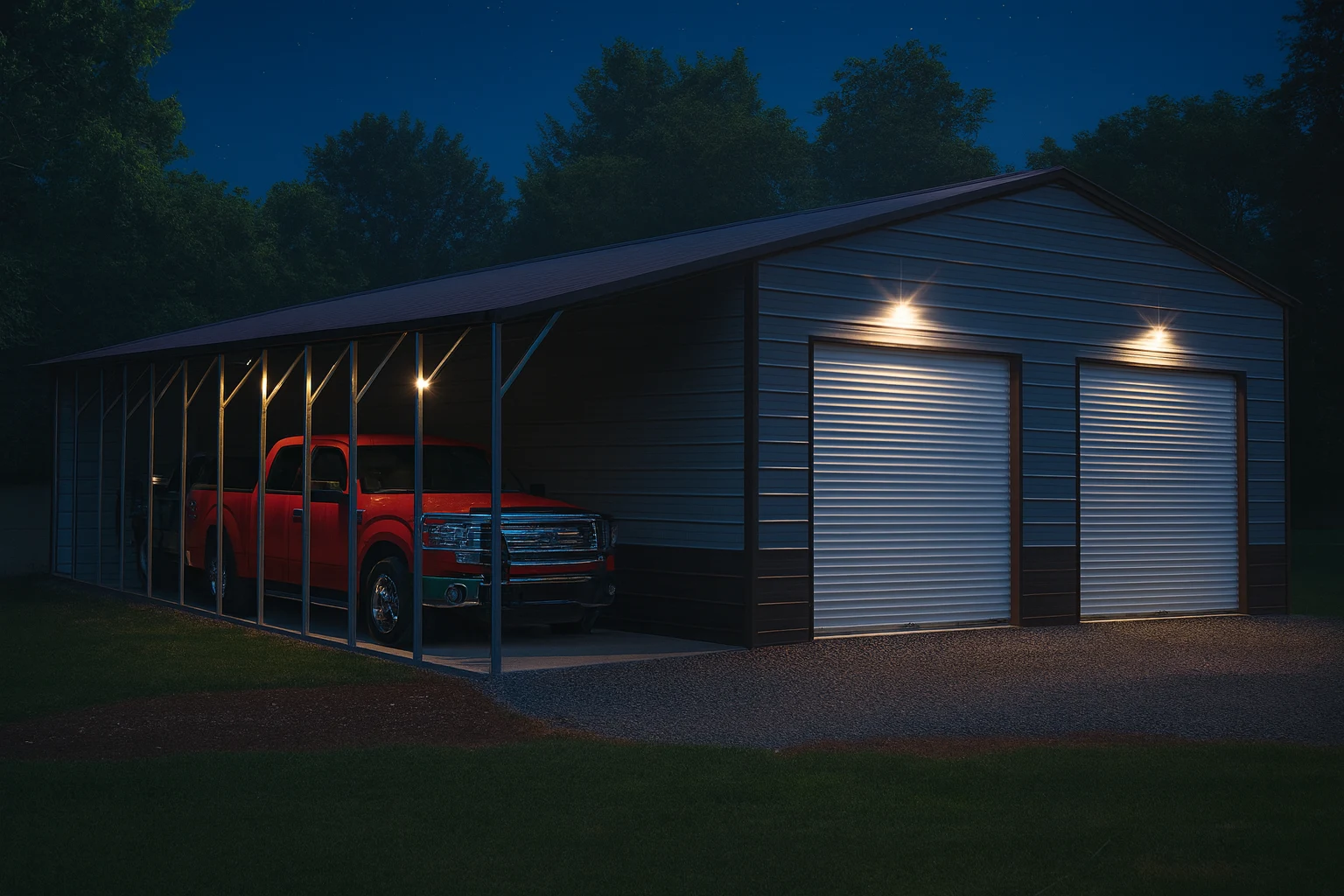
An open-sided or partially enclosed barn costs dramatically less than full enclosure. Gable ends plus one closed side blocks the prevailing weather at a fraction of the price of four walls. Ask honestly what you're protecting against.
Four Places Not to Save
Size. The one irreversible decision. A barn that's too small is a permanent problem, and per-square-foot cost drops as buildings grow — so the "savings" from downsizing are smaller than they look.
Side wall height. Cheap at order, impossible later, and it determines what equipment fits forever.
Certification, if you need a permit. An uncertified building you can't permit isn't a discount, it's a dead end.
Anchors. The cheapest structural component and the first thing to fail when shorted. Your wind rating assumes a specific anchor package.
The Real Math
The most common false economy is downgrading the structure to afford a finish. A buyer drops from 12 gauge to 14 to afford gutters, or shrinks from 40x60 to 30x50 to afford insulation. Both are backwards. Buy the structure, defer the finishes — finishes can be added, structure can't.
For what drives the base price, see metal building cost.