
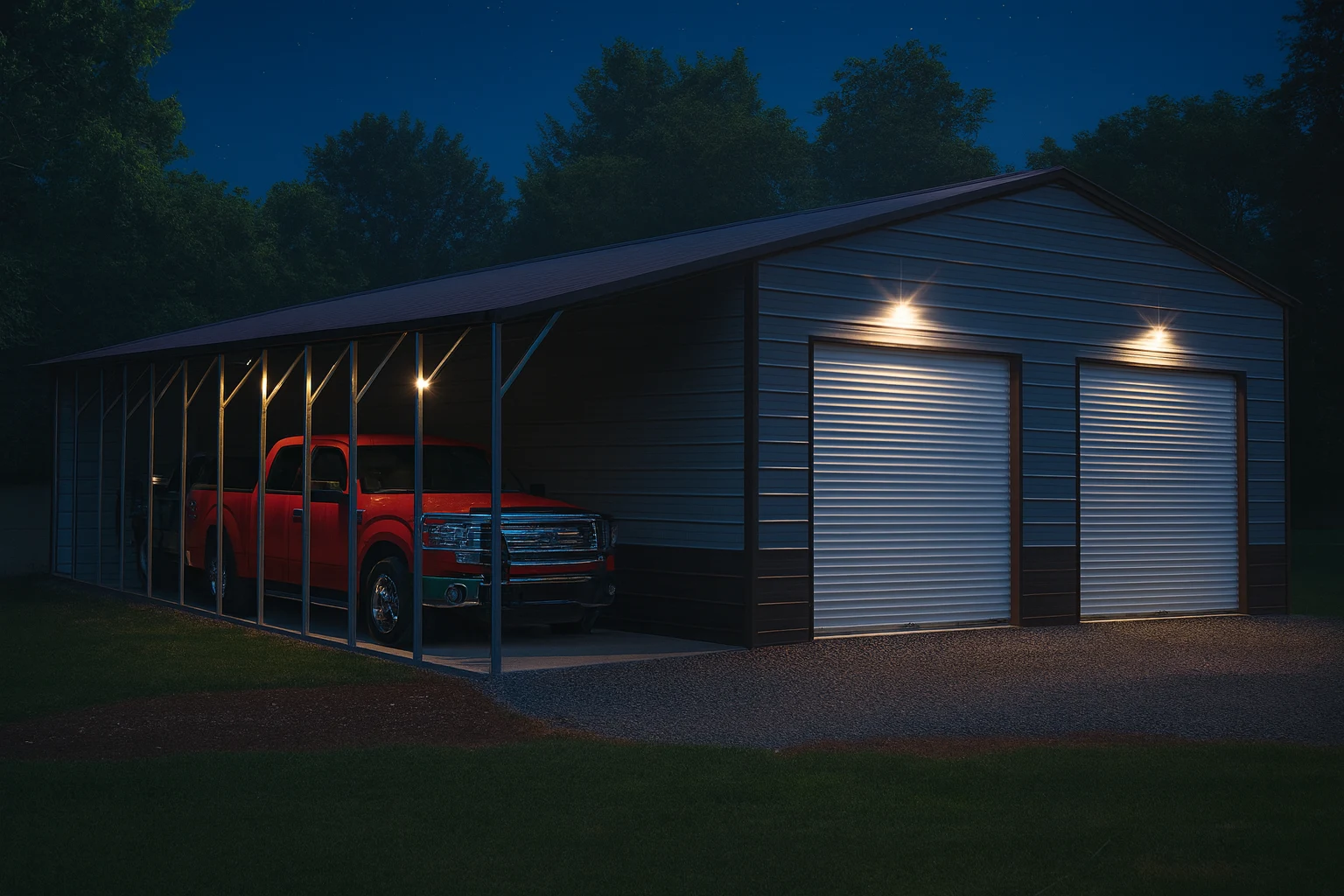
Most residential metal buildings — carports, garages, and barns up to about 14-foot side walls — are installed without a lift. Crews assemble on the ground and raise sections by hand with ladders and standard equipment. Height, span, and site access are what push a job into needing lift equipment, and it's worth confirming before install day rather than discovering it that morning.
When a Lift Is Typically Needed
Tall side walls. Around 16 feet and above, work gets high enough that ladder-based assembly stops being practical or safe.
Wide clear spans. Long trusses are heavy and awkward. Above roughly 50 feet of clear span, mechanical assistance becomes standard rather than optional. See clear span buildings.
Large commercial structures. Red-iron and large-format buildings are engineered on the assumption that equipment will be present.
Difficult terrain. Slopes, soft ground, and constrained footprints can require equipment even on a building that would otherwise assemble by hand.
Certain roof configurations. Steep pitches and tall peaks add working height beyond what the side wall number suggests.
Rough Guide
| Building | Lift typically needed? |
|---|---|
| Carport, 8–12' walls | ✗ No |
| Garage, up to 14' walls | ✗ No |
| 16'+ side walls | ✓ Usually |
| Clear span over 50' | ✓ Usually |
| Commercial / red-iron | ✓ Yes |
| Difficult or sloped site | ✓ Possibly |
Treat this as a starting point. Your dealer should confirm for your specific building and site.
Who Supplies It
This varies by dealer and it's worth settling in writing before you order. Three arrangements are common:
- Included. The crew brings what the job needs and it's in the quote.
- Priced separately. The dealer arranges it and bills it as a line item.
- Customer-supplied. You rent the equipment and have it on site.
The third is where people get caught out — arriving at install day expecting a crew to bring a lift they never agreed to bring. Ask directly: "Does this install require lift equipment, and if so, who provides it?"
Access Matters Even Without a Lift
Every install needs the delivery truck to reach the site regardless of what equipment is used:
- 10–12 feet of clear travel width, more through turns
- Room to turn around — dead-end sites with no turnaround are a genuine problem
- Overhead clearance — power lines and low branches stop a loaded truck
- Firm ground — soft or recently graded ground can bog a trailer
If a lift is needed, add its footprint and its own access requirements to the list. A lift that can't reach the work area is the same as no lift.
Work through the site prep checklist well before install day.
Why Ask Early
If the answer is yes and the equipment isn't arranged, one of two things happens: the install doesn't proceed and you owe a return trip charge, or it proceeds in conditions it shouldn't. Neither is a good outcome, and both are avoidable with one question at order time.