
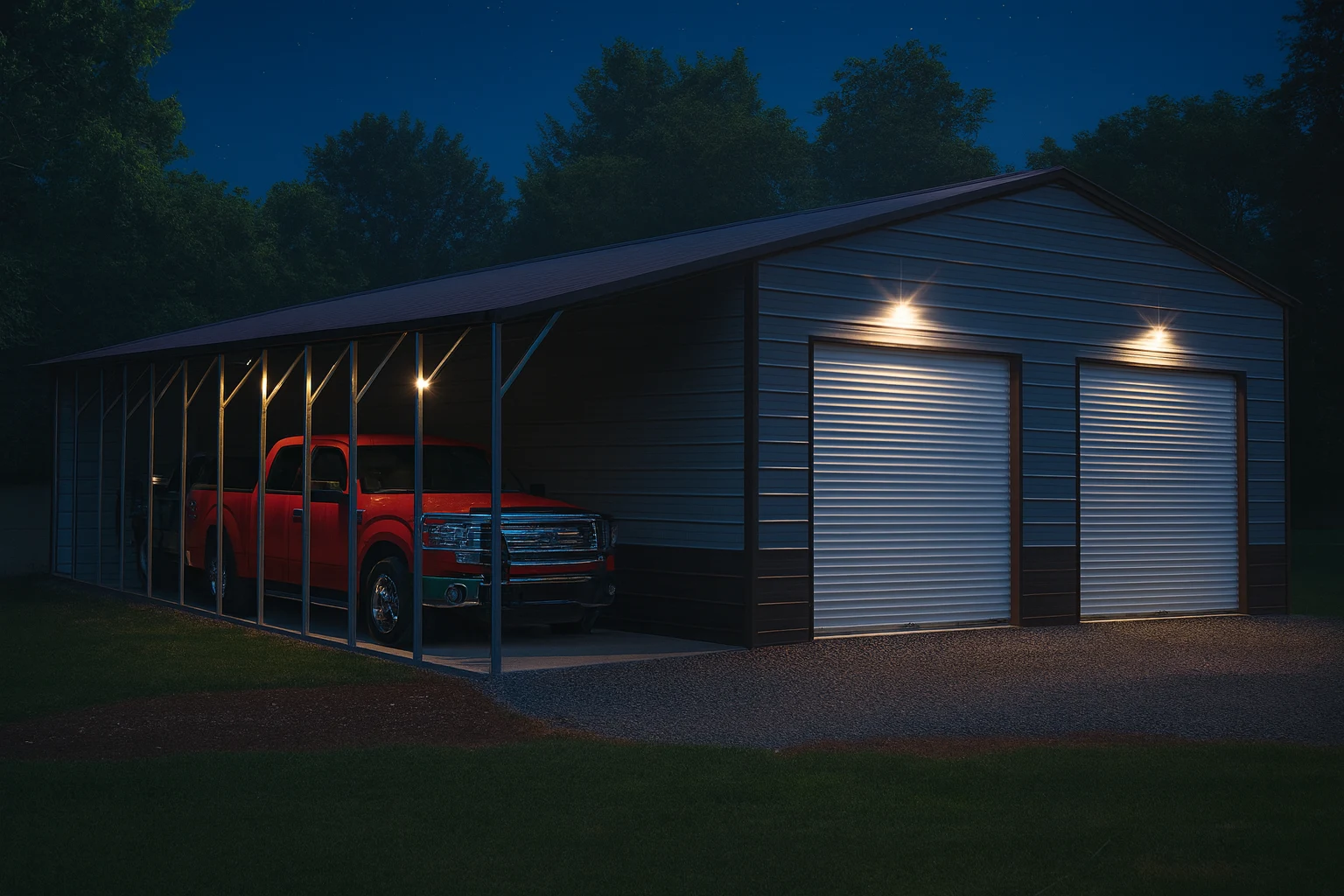
Twelve gauge steel tubing is thicker than 14 gauge — roughly 0.105" of wall thickness versus roughly 0.075". That's about 40% more steel in the frame, which means more strength, more weight, and a longer frame warranty. It also costs more. Whether you need it depends on your loads, your county, and four other variables that matter as much as gauge does.
Lower Number, Thicker Steel
This trips up almost every first-time buyer. Gauge runs backwards: the smaller the number, the thicker the metal. Twelve gauge is heavier than 14 gauge, which is heavier than 16.
| Gauge | Approx. wall thickness | Relative steel content | Typical use |
|---|---|---|---|
| 14 | ~0.075" | Baseline | Standard framing on most carports and garages |
| 12 | ~0.105" | ~40% more | Upgrade framing, required for many certified builds |
Most dealers quote 2½" square tube as the standard frame. The gauge is what changes between a base quote and an upgrade quote — not usually the tube dimension.
What You Actually Get for the Upgrade
More load capacity. A 12 gauge frame handles higher wind and snow loads at the same rafter spacing. In practice this shows up in engineering: if your county requires a certified building rated for higher loads, 12 gauge may be the only way to hit the numbers without tightening rafter spacing.
A longer frame warranty. This varies by manufacturer, but the pattern is consistent — 12 gauge frames typically carry a 20-year rust-through warranty, 14 gauge closer to 10 or 12. Read the actual warranty document, not the sales sheet.
More resistance to handling damage. Thicker tube dents less during shipping, install, and the day you back a tractor into a leg.
More weight. A 40x60 in 12 gauge is meaningfully heavier. That's a benefit structurally and a non-issue practically, unless site access is tight.
The Four Things That Matter as Much as Gauge
Gauge is one input to a structural calculation, not the whole calculation. When you're comparing two quotes, these four move the outcome just as much:
- Rafter and leg spacing. Standard is 5' on center. Dropping to 4' or 3' spacing adds substantially more capacity than stepping up a gauge does. A 14 gauge frame at 4' spacing can outperform a 12 gauge frame at 5'.
- Bracing. Braces at the legs and in the corners control racking. A quote with the same gauge and fewer braces is a weaker building.
- Anchoring. The strongest frame on earth is only rated as high as its connection to the ground. See which anchors you need.
- Certification. A certified building comes with stamped engineering rated to specific wind and snow loads for your address. An uncertified building comes with none of that, whatever it's framed in.
If a competitor's quote leads with "12 gauge" but doesn't state a wind rating, snow load, spacing, or certification status, you can't compare it to anything.
When 14 Gauge Is the Right Call
Plenty of the time. We'll say it plainly because it's true more often than not:
- Low-load regions. Moderate wind zones with little to no snow, where the engineering closes comfortably at 14 gauge.
- Uncertified structures on rural property with no permit requirement, used for storage or vehicle cover.
- Smaller footprints. A 20x20 carport is not a 40x60 barn. Span drives load demand.
- Budget reality. If the gauge upgrade forces you into a smaller building, take the 14 gauge and the extra 10 feet. Owners regret the size they didn't buy far more often than they regret the gauge.
When to Insist on 12 Gauge
- Your county requires certified engineering and the loads don't close at 14 gauge
- High wind zones, coastal exposure, or meaningful ground snow load
- Wide clear spans, tall side walls, or a fully enclosed building carrying wall and roof load
- Commercial or occupied use, which likely puts you in a higher risk category
- You plan to hang a lift, mezzanine, or heavy equipment from the structure
How to Compare Two Quotes in Five Minutes
| Ask for this | Why it matters |
|---|---|
| Frame gauge and tube size | 12 gauge in a smaller tube isn't automatically stronger |
| Rafter/leg spacing (on center) | Spacing can outweigh gauge entirely |
| Wind rating (mph) and snow load (psf) | The only numbers that describe actual performance |
| Certified or non-certified | Determines whether you can permit it |
| Frame warranty length, in writing | Where gauge really shows up long-term |
| Anchor type and count | Governs the whole rating |
Two quotes that both say "12 gauge" can be 25% apart in real capacity. These six lines are how you find out which one you're holding.