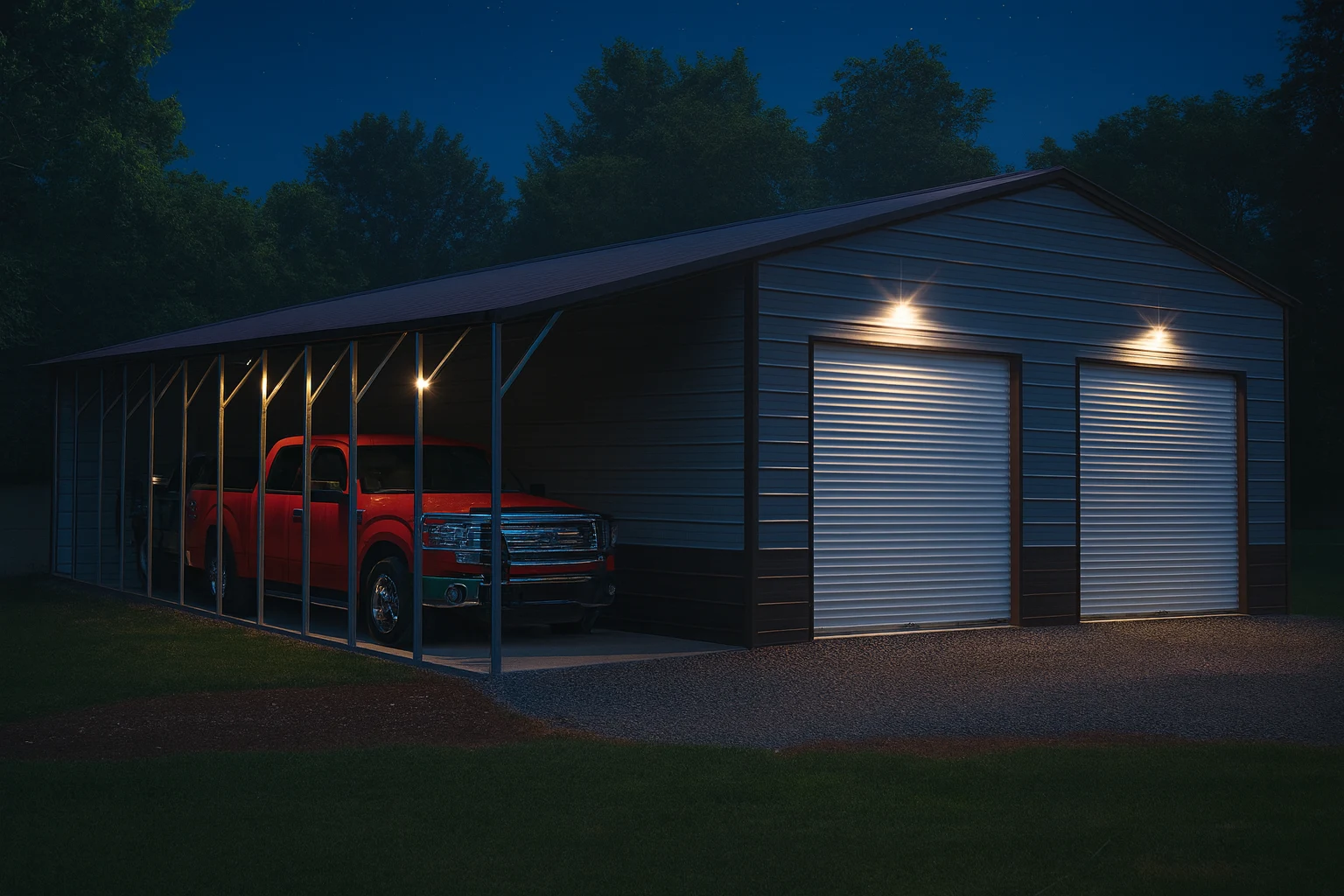
Vertical panels run up and down, so water, snow, and debris slide off. Horizontal panels run side to side, so anything landing on them has to travel across every seam to get off. Vertical costs more — typically 10–20% on the roof — and is worth it in most climates. Horizontal is a legitimate choice on small, open structures in mild weather.
The Difference in One Sentence
Vertical panels give runoff a straight path down. Horizontal panels don't.
That's the entire performance argument, and it's a bigger deal than it sounds. Every seam a panel has is a place water can sit, freeze, and work its way in over years. Orientation decides whether gravity is helping or fighting.
What Vertical Panels Require
Vertical panels can't attach directly to the frame the way horizontal panels do. They need hat channel — additional framing members running perpendicular to the panels to screw into. That's more material and more labor, which is where the cost difference comes from.
It's also why some quotes are cheaper than others in ways that aren't obvious. A quote with vertical panels includes structure a horizontal quote doesn't.
Side by Side
| Vertical | Horizontal | |
|---|---|---|
| Water shedding | ✓ Straight path down | ✗ Crosses every seam |
| Snow performance | ✓ Sheds readily | ✗ Accumulates and holds |
| Debris and leaves | ✓ Slides off | ✗ Collects at seams |
| Cost | ✗ 10–20% more on the roof | ✓ Lower |
| Required framing | ✗ Needs hat channel | ✓ Attaches directly |
| Panel length | ✗ Limited by roof run | ✓ Runs building length |
| Resale perception | ✓ Seen as the upgrade | ✗ Seen as base spec |
| Wide buildings | ✓ Often required | ✗ Sometimes not offered |
Roof, Walls, or Both
These are separate decisions and they don't have to match.
The roof is where it matters most. If you upgrade one surface, upgrade the roof. It takes all the weather, holds all the snow, and collects all the leaves. A vertical roof over horizontal walls is a common and sensible combination.
Walls are more about appearance and longevity. Vertical walls read as a higher-spec building and shed rain running down the face. The performance gain is smaller than on the roof.
When Horizontal Is Genuinely Fine
- Open carports in mild climates with no snow load
- Small structures under about 400 square feet where the roof run is short
- Budget-constrained builds where the money is better spent on frame gauge or square footage
- Temporary or utility structures you don't expect to keep for decades
If you're in the Southeast covering a boat on an open carport, horizontal panels will serve you fine for a long time. Spend the difference on something structural.
When Vertical Is Worth Insisting On
- Any measurable snow load. This is the strongest case. Horizontal seams give snow a place to sit and melt-freeze cycles a place to work.
- Wide buildings. Longer roof runs mean more water crossing more seams. Many manufacturers require vertical roofs above certain widths.
- Under trees. Leaves and needles collect at horizontal seams and hold moisture against the panel.
- Anything you're keeping 20+ years. The difference compounds.
- Certified buildings. Vertical is frequently specified as part of the engineering.
What This Doesn't Change
Panel orientation isn't panel thickness, and it isn't frame strength. Panels are typically 26 or 29 gauge sheet steel regardless of which way they run, and neither orientation changes your wind rating. If a quote is selling vertical panels as a structural upgrade, that's overstating it — it's a weather and longevity upgrade.
For what actually drives structural capacity, see 12 vs 14 gauge steel framing.