
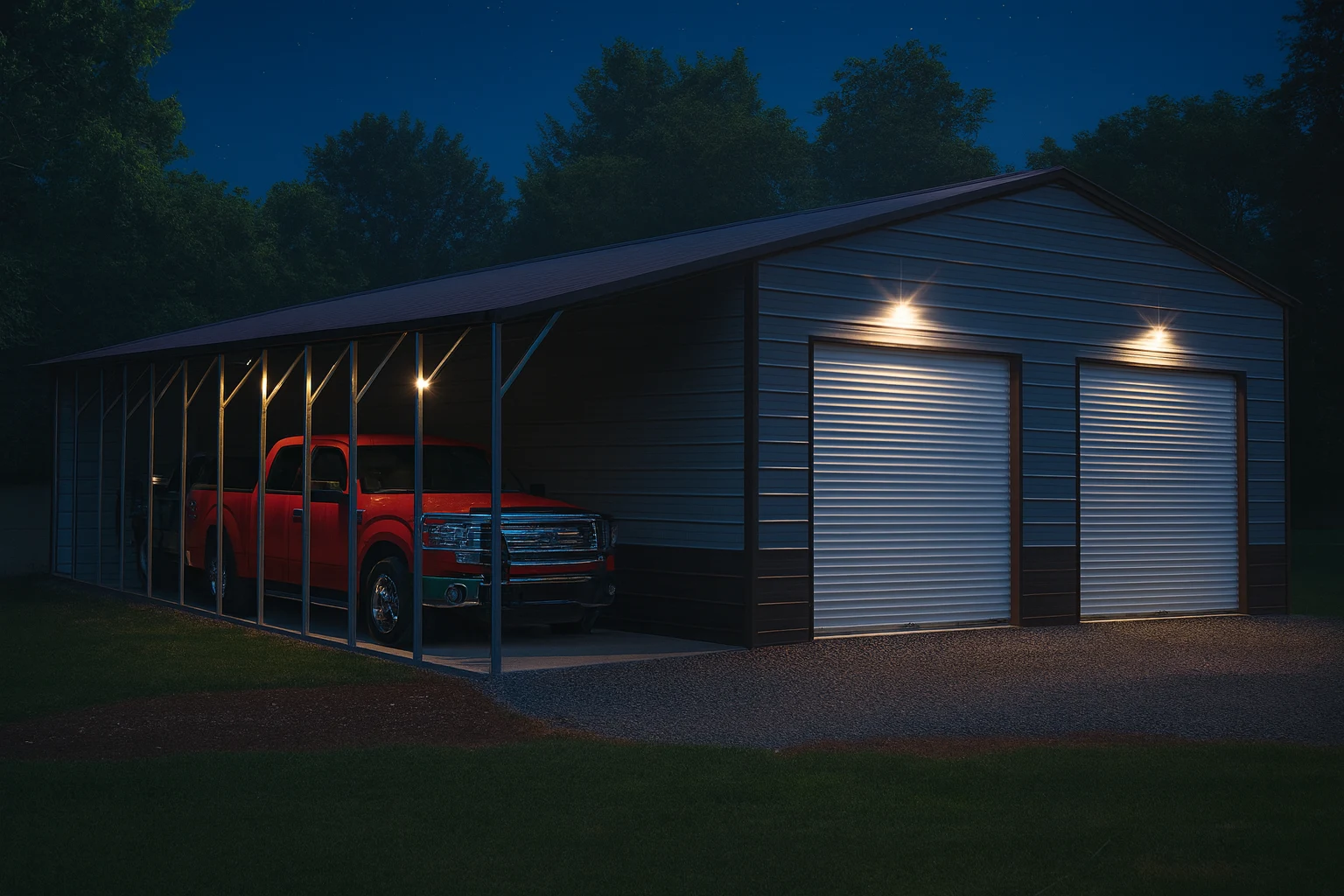
Your base decides your anchor: rebar or auger anchors for ground and gravel, concrete wedge anchors for slabs and piers, asphalt anchors for paved surfaces. Anchor type and count are part of the engineering that produces your wind rating — not accessories you can economize on.
Why This Matters More Than It Sounds
A building rated for 140 mph winds is rated on the assumption that it stays attached to the ground. Uplift is what wind does to a roof, and every bit of that force travels down the frame and into the anchors. Under-anchor the building and the rating on your paperwork describes a structure that doesn't exist on your property.
This is also the most commonly shorted item on a cheap quote, because it's invisible once installed.
The Four Types
Rebar anchors
Steel rods driven at an angle through the base rail into the soil, typically 30–36 inches long. The standard for buildings on bare ground or gravel.
- Use with: ground, gravel
- Strengths: inexpensive, fast, no concrete required
- Limits: pullout resistance depends entirely on soil. Sandy or loose soil holds poorly.
Auger / mobile home anchors
Helical anchors screwed into the ground, resisting pullout by the load on the helix rather than friction. Substantially more holding power than rebar.
- Use with: ground, gravel — especially in high wind or poor soil
- Strengths: much higher uplift resistance, verifiable installation torque
- Limits: more expensive, slower to install, can be defeated by rock
Concrete wedge / expansion anchors
Driven into holes drilled in cured concrete, expanding to grip the hole. The standard for slabs.
- Use with: concrete slabs, piers, footings
- Strengths: highest and most predictable holding values
- Limits: requires cured concrete of adequate thickness and edge distance. Too close to a slab edge and the concrete spalls instead of holding.
Asphalt anchors
Long anchors designed for asphalt's lower density, usually with an expanding or barbed profile.
- Use with: existing asphalt
- Strengths: allows installation on paved lots without concrete work
- Limits: asphalt thickness and base condition matter. Verify before assuming.
Matching Anchor to Base
| Base | Anchor | Notes |
|---|---|---|
| Bare ground | Rebar or auger | Soil type drives which |
| Gravel pad | Rebar or auger | Anchor must reach soil beneath the gravel |
| Concrete slab | Wedge / expansion | Check thickness and edge distance |
| Concrete piers | Wedge / expansion | Anchor into the pier, not between |
| Asphalt | Asphalt anchors | Verify thickness first |
For a breakdown of the bases themselves, see foundation options.
Count Matters as Much as Type
Every leg gets anchored — that's the minimum, not the spec. Certified buildings specify a count derived from the wind rating, the building's size, and its exposure. Larger, taller, wider, and windier all mean more anchors.
When comparing quotes, ask for anchor type and quantity, in writing. A quote that says "anchors included" without either number is telling you nothing. Two identical buildings with different anchor packages are rated differently, and only one of them may satisfy your permit.
Common Mistakes
- Anchoring gravel instead of soil. Rebar has to pass through the gravel and into the ground beneath it. An anchor that stops in the stone holds almost nothing.
- Drilling too near a slab edge. Concrete near an edge breaks out under load. Edge distance is specified for a reason.
- Anchoring green concrete. Concrete needs to cure before it takes wedge anchors. Ask your dealer for their minimum.
- Assuming rebar is universal. In sandy soil or high wind, rebar may not be enough. Auger anchors exist for exactly this case.
- Treating anchors as the place to save. They're the cheapest part of the structural system and the one that fails first when shorted.